Gas fireplace or wood-burning: Which is more eco-friendly?
The warmer weather doesn’t always prompt thoughts of sitting in front of a cozy fire, but if you are considering adding or making a change to a fireplace in your home, now might be the right time to start thinking about that new or improved wood-burning or gas fireplace.(more…)
What is a Zero Clearance Fireplace?
Image source: ctsweep.com
If you have plans to add a new fireplace to your home this year, or plan to make changes to your existing fireplace, you may have come across the term “zero clearance fireplace.”
What is a zero clearance fireplace, anyway? Zero clearance fireplaces are built in a factory. By definition, the pre-manufactured unit or firebox can be placed up against combustible materials like wood, wall, or paneling. This construction eliminates the need for a buffer of any type, allowing the firebox to fit into a much smaller opening than traditional masonry fireplaces.
The outside of the box itself doesn’t get hot enough to burn other materials. Zero clearance fireplaces are also less expensive, and much more efficient than masonry-style fireplaces, and can be designed to fit into small areas without the addition of a costly foundation. These fireplaces can also easily be installed on second stories of a home or building.
Zero clearance fireplaces can be used in any home, and certain models have even been installed in mobile homes.
Because you don’t have to be concerned with masonry or chimney repairs, zero clearance fireplaces are much lower maintenance. Zero clearance fireplaces also cost less to install than a masonry fireplace.
In addition to costing less to install, they’re also more cost-efficient, and are able to achieve 70% efficiency in comparison to masonry fireplaces, that can sometimes have an efficiency rating as low as 10%. Zero clearance fireplaces also allow you to choose whether you want to burn gas or wood.
So if you’re looking for options when it comes to adding another fireplace to your home, consider adding a zero clearance fireplace. It’s a cost-effective, flexible, and energy efficient choice for your home.
Fireplace Cooking Tips for Fun and Delicious Meals
Doing “Fun by the Fire Friday” posts every week, we share a lot of fun ideas for what to do by the fire. Sometimes this includes eating in front of the fire, or near the fire, but we don’t talk much about HOW to cook food OVER an open fire.
While some types of fireplace cooking require special equipment, like a fireplace grill, others can be done on most any fireplace with a little creativity and ingenuity. It’s all about using the right tools.
Image source: YouTube.com
How to Cook in Your Fireplace
We’re not all great cooks, but to cook over an open flame requires not just skill, but also equipment built for the task.
Here are some items that will help you cook like a pro in your fireplace.
Fireplace rotisserie-A fireplace rotisserie can take a little practice to get right. A rotisserie is essentially a spit set up in front of the fire that turns the meat over slowly as it cooks over an open flame. A rotisserie generally runs with a small motor or can be turned by hand.
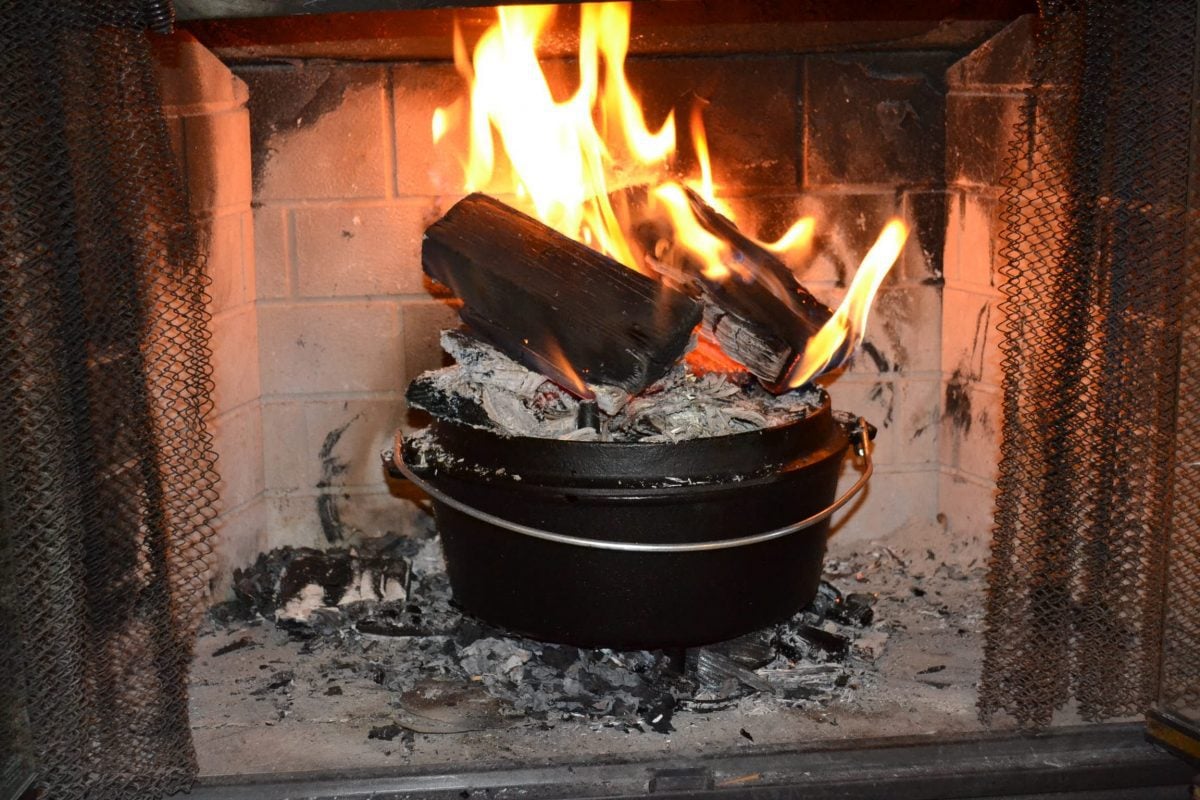
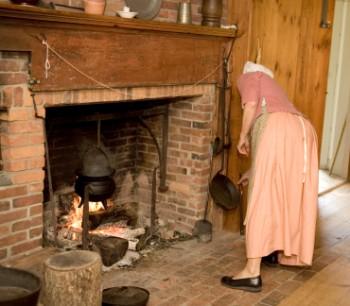
Fireplace Crane for Dutch Ovens-You’ve probably seen pictures of these in American history books, or have seen them in use in old movies. A Dutch oven is a heavy duty cast iron pot with a lid that has a metal handle that you can hang it from. The crane is the piece you attach to the wall, and use to hang your Dutch oven from. Just find a proper hinge to install near your fireplace opening, and you can hang a Dutch oven over the fire and cook right there! Using a Dutch oven in this fashion allows for slow simmering and stewing of foods, and with the right recipe the end results will be delicious!
Fireplace Grills-Much like your barbeque grill, you can purchase a single grill plate to place on a fire burning in your fireplace that will allow you to set a kettle on top, grill steaks, chops, vegetables-whatever you want to cook over an open flame.
Pie Irons-Pie iron cooking makes it possible for you to create toasty desserts and sandwiches like paninis.
Skewers-I am a firm believer that food is just better when cooked on a skewer and slightly singed. I love kebobs of all kinds, and this also works great for hot dogs and sausages. I’ve even roasted small game birds over the fire using skewers. They were delicious.
Now that I am getting hungry, I think it’s time to get dinner together. A nice, toasty Panini would really hit the spot!
Cozy Family Room Fireplace Ideas
With the amount of time many families spend in their family room, whether it is sitting in front of a fire relaxing, interacting, sharing a meal, or just having fun, its no surprise that the family room has become the focal point of many homes. (more…)
Reasons to Add a Gas Fireplace to Your Home
Lately we have discussed electric fireplaces vs. wood burning fireplaces, and why electric fireplaces are a nice choice for people who rent, and don’t have their own fireplace but still want to enjoy the ambiance of a fire. (more…)
Pros and Cons of Electric and Wood Burning Fireplaces
Thinking about adding a new fireplace to your home? With so many options out there, from wood burning to electric fireplaces, it’s important to the advantages and disadvantages of each type of fireplace. (more…)
Cozy Fireplace Spaces for Your Home
We are almost at the end of the coldest part of the year here in North America. But even though the weather is beginning to warm up, it’s always a good time to come up with new ways to spruce up our homes and fireplaces. (more…)
The Cost of Adding a Fireplace to Your Home
A warm, inviting fireplace is a lovely addition to make to any home. There are lots of choices to be made when deciding which type of fireplace you’d like to feature in your home.
The most traditional type of fireplace is a brick or stone, with a chimney built into your home. Brick and stone fireplaces can also often be the most expensive fireplaces to add to your home. Another type of fireplace, an insert fireplace, are much more common now, not to mention more affordable. Insert fireplaces require a fairly simple flue, and can be easy to install. Fireplace inserts are also produced a number of designs.
If you prefer a non-wood burning fireplace instead, gas and electric fireplaces come in many different styles, and with a number of features.
Wood Burning Fireplaces
Wood burning fireplaces are what many of us have come to expect a fireplace to be—wood burning, built with brick or stone, a chimney, and a firebox. Wood burning fireplaces are not installed as often these days, but many will agree, they can be the most stunning, and help form the centerpiece of a living area.
Wood burning fireplaces also need the most maintenance, from cleaning, to ensuring the mortar in the brick or stone is kept in good repair, plus chimney inspections and cleaning. On average, if you plan a wood burning fireplace for your home, you should budget at least $8,000 and probably closer to $15,000 to complete the project, with elaborate fireplaces costing more than that.
Wood-Burning Insert Fireplaces
A wood-burning fireplace insert is a more economical choice than a traditional wood-burning fireplace. The fireplace insert unit comes with a firebox and insulation. For a fireplace insert, the chimney can be a standard framed chimney, and will not require brick or stone. The flue will be a double-wall type with airspace between the walls. The advantages of fireplace inserts are that they cost less and are lower maintenance when compared to a wood burning traditional fireplace. Many inserts are fitted with blowers that heat air drawn from the room with the use of a heat exchanger, then send it back—or return it—into your home. Costs for this type of fireplace and chimney, range between $1,000-$3,500. If you want a framed and sided chimney, the costs will generally be between $1,500-$3,000.
These types of fireplaces are growing in popularity because they are energy-efficient and come with a lower price tag, however, there are some differences.Some of the top picks are very cost effective and affordable.
Gas inserts require venting but electric fireplaces do not. These types are common in living rooms, kitchens, dens, and bedrooms. Depending on how elaborate the design is and what features it offers, the costs can start at approximately $500 and range up to about $2,000, sometimes more.
Hiring a Professional
If you’re considering a brick or stone fireplace, hiring a professional contractor is going to be your best option. The safety risks are too great to attempt to build this type of fireplace on your own. Wood-burning fireplace inserts are simpler to install, but you may also want to consider hiring a professional for safety reasons. Gas inserts can also present significant concerns, because you need to provide a gas line to power the fireplace, so to ensure your gas fireplace is properly installed, it’s best to call in a professional.
Without question, a fireplace will add beauty, ambiance, and an added sense of comfort to your home. Fireplaces can also add value to your home, increasing the potential asking price for your home by as much as 14%, making it a great investment for your home.
Tips for Planning Your Outdoor Fireplace
The weather may not be the most conducive right now to start thinking about adding an outdoor fireplace to your property, but just like any other project you are considering for your landscape and home, it’s important to put a bit of thought and planning into it before you break ground or spend money. (more…)
The History and Evolution of Fireplaces
Image source: interiordesign.lovetoknow.com
When they first began making an appearance inside of our homes, fireplaces were more practical than decorative.
That’s because fireplaces served very important purposes in the beginning. First, the hearth itself was a source of heat and warmth. In addition to providing added warmth to a home, early American fireplaces were also used as a place to cook and prepare meals. Not limited to cooking over an open flame, the hearth was also used as a tool to facilitate baking.
In the 17th and 18th centuries, the fireplace was large enough to allow someone to “walk-in.” The hearth was a wide, deep and open recess in a room, with a small mantel (if there was a mantel). The firebox was generally wider than it was tall.By contrast, fireplaces in English homes were smaller, and considered to be much more efficient. By design, colonial homes in America, particularly those built in the New England and Mid-Atlantic regions, were built with central chimneys with multiple flues. Because these fireplaces were more centrally located inside of these homes, the materials used to construct these fireplaces—a collection of brick and stone—also helped retain heat. By comparison in the South, fireplaces were located toward the ends of a home, to keep heat at a minimum, and help keep houses cooler in the summer.
The treatment of the fireplace as a potential object of beauty in a home began to come into its own in the middle of the 18th century. At this point in its evolution, the fireplace began to feature beautifully carved mantels, and details like dentils and inset panels.
Still huge, cavernous fireplaces continued to be popular into the 19th century. However, sometime around 1795 conventional fireplace design did begin to change. Sir Benjamin Thompson, known to many as Count Rumford, began working with the shape and design of the firebox. As a result, a modern fireplace opening is taller than it is wide, and smaller and shallower than earlier fireplace designs. Because of Rumford’s sharper angles on either side of his fireplace design, more radiant heat is shared with the room where the fireplace is situated. Another important feature of Rumford’s design is its narrow “throat,” which pulls smoke and air more quickly, and helps aid against backdrafts.
In addition to changes to the firebox, aesthetic design changes moved to the forefront after the Revolutionary War. During this time, lovely decorative elements like reeding, swags, star and shell accents and Federal and Greek Revival design-style mantels came into style. Today, the breadth and depth of fireplace and mantel-related design has exploded based on these earlier, more modest design elements.
The Victorian era ushered in much more ornate designs—intricate overmantels, mirrored displays, and elaborate tile displays, were some of the more prominent design elements available in the Victorian era.
During the mid-1800s, fireplaces also saw changes and modifications necessary to make it possible to burn more coal in more urban settings. This also brought with it the use and application of cast-iron features differently applied for safety and design purposes.
In the early 19th century, following a period hallmarked by ornate and fanciful designs, fireplace and mantel design returned to a simplicity of style more commonly found in the late 18th century, during Colonial times. In addition, in order to accommodate the Bungalow and Arts and Crafts home movements, an upsurge in banquette-flanked hearths complete with copper hoods and glazed tiles took hold. But before these dominant styles dominated, the back-to-nature movement inspired by Teddy Roosevelt spawned fireplaces built with river rock or stone.
While the overall shape of the modern fireplace has not changed much over time, the dimensions, uses and design options for today’s fireplaces are more diverse and creative than ever imagined. In the end, though, a couple of things remain constant. The unmistakeable ability of a fireplace to provide warmth, comfort, and relaxation to those of us who love to sit in front of a crackling, enchanting fire and relax.
Awesome Ideas for Unexpected Fireplaces in Your Home
Fireplaces are a beautiful addition to any home regardless of where they are placed. (more…)
Unique and Unexpected Fireplace Designs for the New Year
I’m always on the lookout for new and unique ideas for fireplace designs, something that opens my eyes and makes me say “Wow, I love that.” (more…)
2016 Trends for Home Decor and Fireplaces
When describing fireplace, home decor and design trends in 2016, the most often used terms offered by the experts are details, customization, and personalized living spaces. (more…)
How to Stack Firewood for Your Fireplace
Now that it is finally starting to get chilly in some locales and the holidays are upon us, it’s time to think about stocking up on some firewood for the colder months ahead. (more…)
All This Story Needs is a Roaring Fireplace
Now typically because I love fireplaces, and I am always looking at fireplace accessories, makeovers and products, I feature a lot of fireplace-related content on the Brick-Anew blog. Today’s just a little different. (more…)
Gorgeous Fireplaces That Live Up To Their Name
With the holidays just about here, we’re all looking for something special, beautiful even gorgeous to look at this season, and that includes fireplaces! (more…)
The Advantages Of A Gas Fireplace
Ahhh….there’s nothing better than the relaxing warm glow from a fireplace at the end of a long day. The flames calm and comfort you no matter how stressed out you are.
I’m always a little sorry for people who don’t have a fireplace in their home, especially when they live in an area with super cold winters. But there’s hope! I ran across this blog post recently on the Heat&Glo website, www.heatnglo.com, and I thought I’d share it with you. The writer did a fantastic job of spelling out why installing a gas fireplace in your home is a great idea.
Gas Fireplace
“According to the National Center for Real Estate Research, fireplaces can increase the value of your home by 6 to 12%!”-Heat&Glo Blog
Check out the Heat&Glo blog to learn all of the “Top 10” reasons why you should consider adding a gas fireplace to your home. Enjoy!